
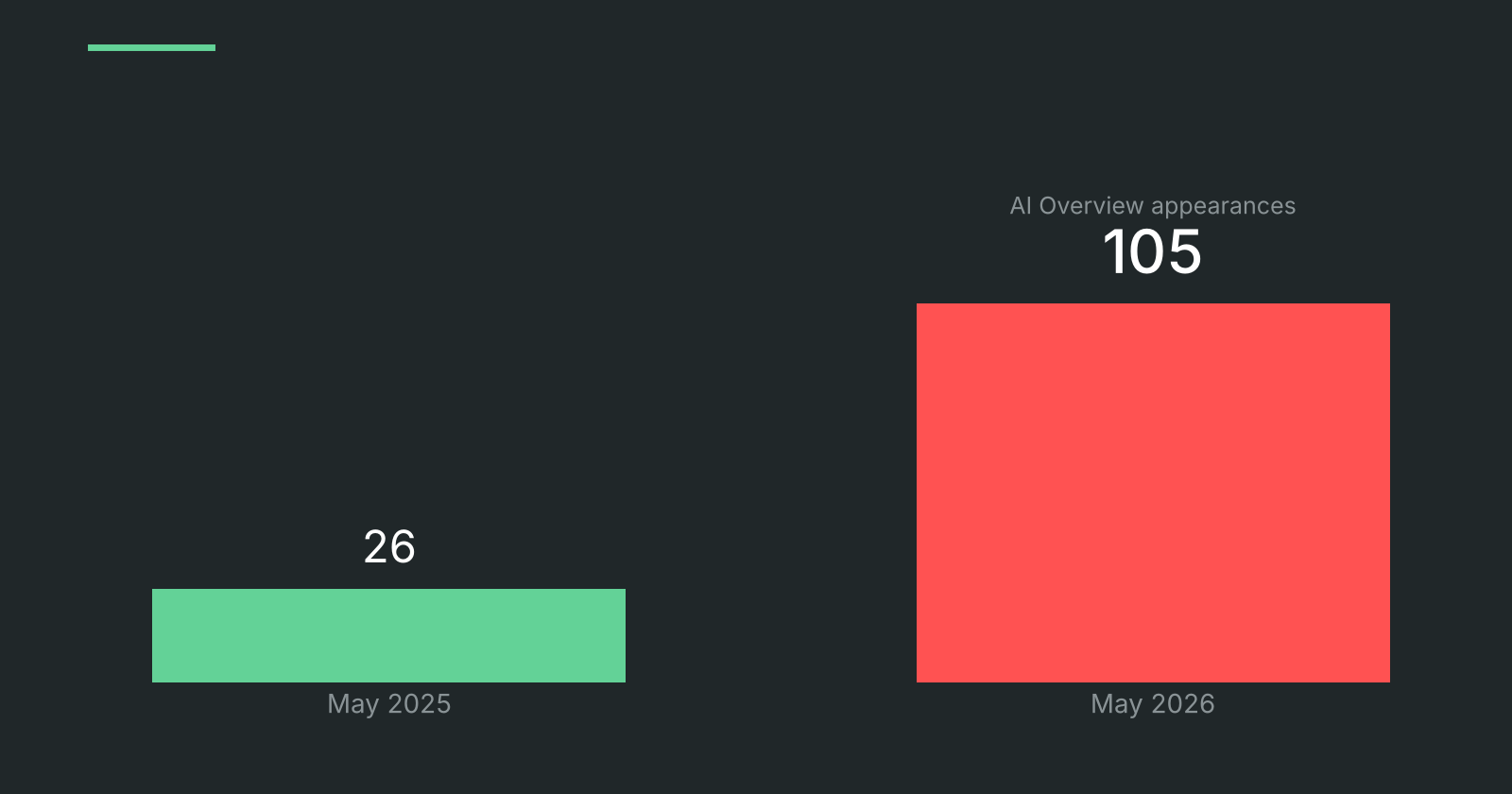
We ran a content-led PR campaign for a large brand that sells things like company swag and custom apparel, built on a workplace survey. A product category page that received most of the campaign's links went from 26 Google AI Overview appearances in May 2025 to 105 in May 2026.
By May 2026, the same page ranked #1 for 3 product terms with about 52,000 combined monthly searches.
Our client has its own PR team, which goes after top-tier media and big brand moments. That team doesn't go after the trade blogs, niche sites, and small business publications that link to product pages and that AI tools pull from.
Its product category pages leaned mostly on the brand's existing authority, and the brand wanted those pages to earn fresh links of their own.
So we built each campaign around a product page that sells, and judged each campaign on that page's rankings and AI visibility.
We run campaigns on a repeating cycle with 4 parts.
We vet topic ideas for search demand, media interest, and a direct tie to a product category. Since April 2024, we've presented 48 topic ideas and launched 16 campaigns.
For this campaign, we picked workplace recognition, because it tied straight to the brand's apparel and corporate gift products.
We shape each survey so the findings make a story a writer would want to cover.
We help shape the survey questions and the data story, and our client publishes the report on its own site, so the links land on the brand's domain.
We pitched the findings to trade publications, niche bloggers, and small business sites, and asked for links to the product page the data supported. 11 of this campaign's 18 links went straight to that product category page. (More on how we run content-led PR.)
We recommend refreshing the best-performing surveys each year so they keep earning links, and we report rankings and AI Overview appearances for every target page.
We also test how often the brand shows up in AI answers across its product categories. (Here's how our AI search and SEO work fits together.)
The product page that received 11 of the campaign's links showed up in 26 Google AI Overviews in May 2025 and 105 in May 2026.
| Page or measure | Result |
|---|---|
| Product page from this campaign (May 2025 to May 2026) | 26 to 105 AI Overviews |
| Second product page, separate campaign (May 2025 to May 2026) | 4 to 64 AI Overviews |
| Third product page, separate campaign (May 2025 to May 2026) | 14 to 41 AI Overviews |
| Gift ideas guide from a 2025 campaign (May 2025 to May 2026) | 0 to 64 AI Overviews |
| Content-led PR campaigns since April 2024 | 16 |
| Links from those campaigns | 140 |
By May 2026, the same product page ranked #1 for 3 product terms with about 52,000 combined monthly searches.
A separate survey campaign sent 6 of its 18 links to another product page, which went from 4 to 64 AI Overview appearances over the same year. A third campaign sent 13 of its 24 links to a product page that went from 14 to 41.
Our client doesn't share sales data with us, so we can't tie these pages to revenue. Other teams also work on these pages, so we don't claim every gain. We judge our work on the pages that sell: their rankings, their links, and how often AI answers cite them.
Point every campaign at a page that sells. 11 of 18 links went to a product category page, and that page is where the gains showed up.
Cover the long tail your PR team skips. Trade blogs and niche sites rarely make headlines, and they're often the sources AI answers pull from.
Refresh the reports that work. A survey keeps earning links and citations for as long as its data stays relevant, so a yearly refresh costs less than starting over.
Report on the page you pointed links at. We track rankings and AI Overview appearances for each target page, so every campaign gets judged on what it did for the product it supports.
About the numbers: AI Overview counts and rankings come from Semrush, and link counts from our outreach tracking. All numbers run through May 2026. Our client doesn't share sales data with us. We don't name clients without their written permission.
We'll run 5 of your buyers' questions through ChatGPT, Perplexity, and Google AI Mode and show you who wins each one. You get a free 1-page Snapshot and a 3-minute video from Matthew.
GET YOUR FREE SNAPSHOT